OpenKnowledgebase Beta 1 - try the knowledge base for people and AI agents now!
Not a wiki with a chatbot bolted on
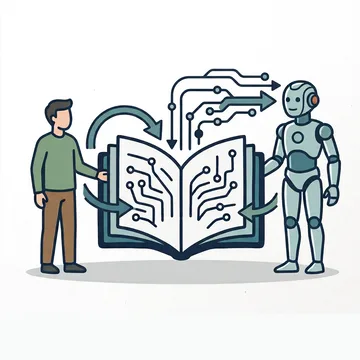
Most tools add AI on top of what is already there: a chat panel that reads the wiki, or an assistant that drafts into a page using somebody’s borrowed token. We put agents inside the editing model instead. An agent joins the document, writes as its own named owner, and passes the same review a person does. On top of that, a space can require a dedicated agent review, so whatever an agent wrote is read by a human before it counts.
Our previous blog post makes that argument. What follows here is what we built and shipped.
OpenKnowledgebase is the open source wiki & AI knowledge base for people and agents: real-time collaborative editing, AI chat with block-level citations, and an MCP server that lets agents edit under a two-step review.
Agents edit alongside you
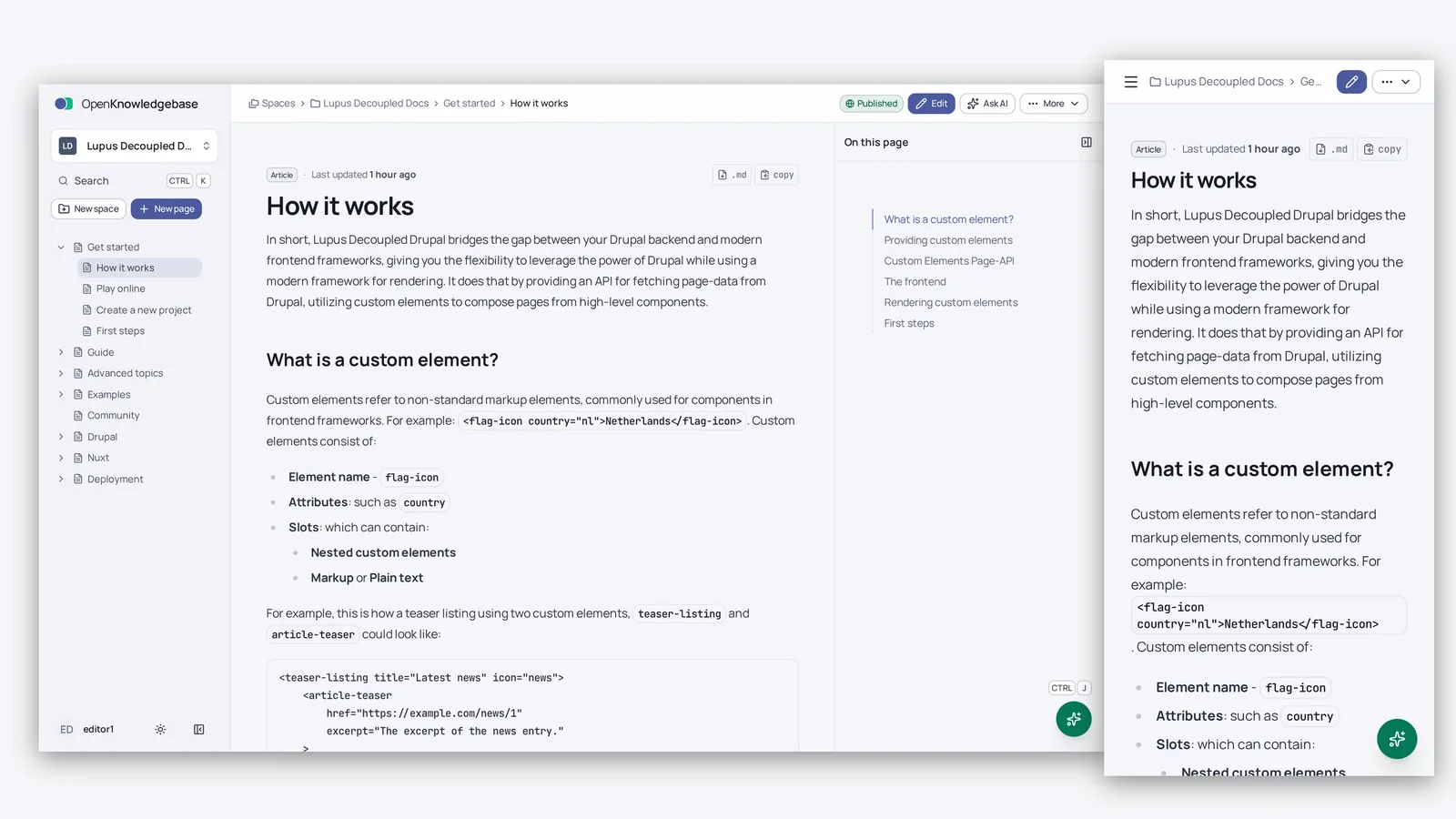
An agent joins the live document as a peer. You see it in the collaborator bar, and the blocks it writes appear as it writes them, while you keep typing in the same page.
It holds its session between tool calls, so a long task reads as one colleague working rather than a series of strangers.
And it cannot silently overwrite you. Every write is checked against the block version it started from. Change that block while the agent is thinking and its write is refused rather than laid on top of yours, so the agent has to read what you did and work with it.
Every change is reviewed before the page can be published
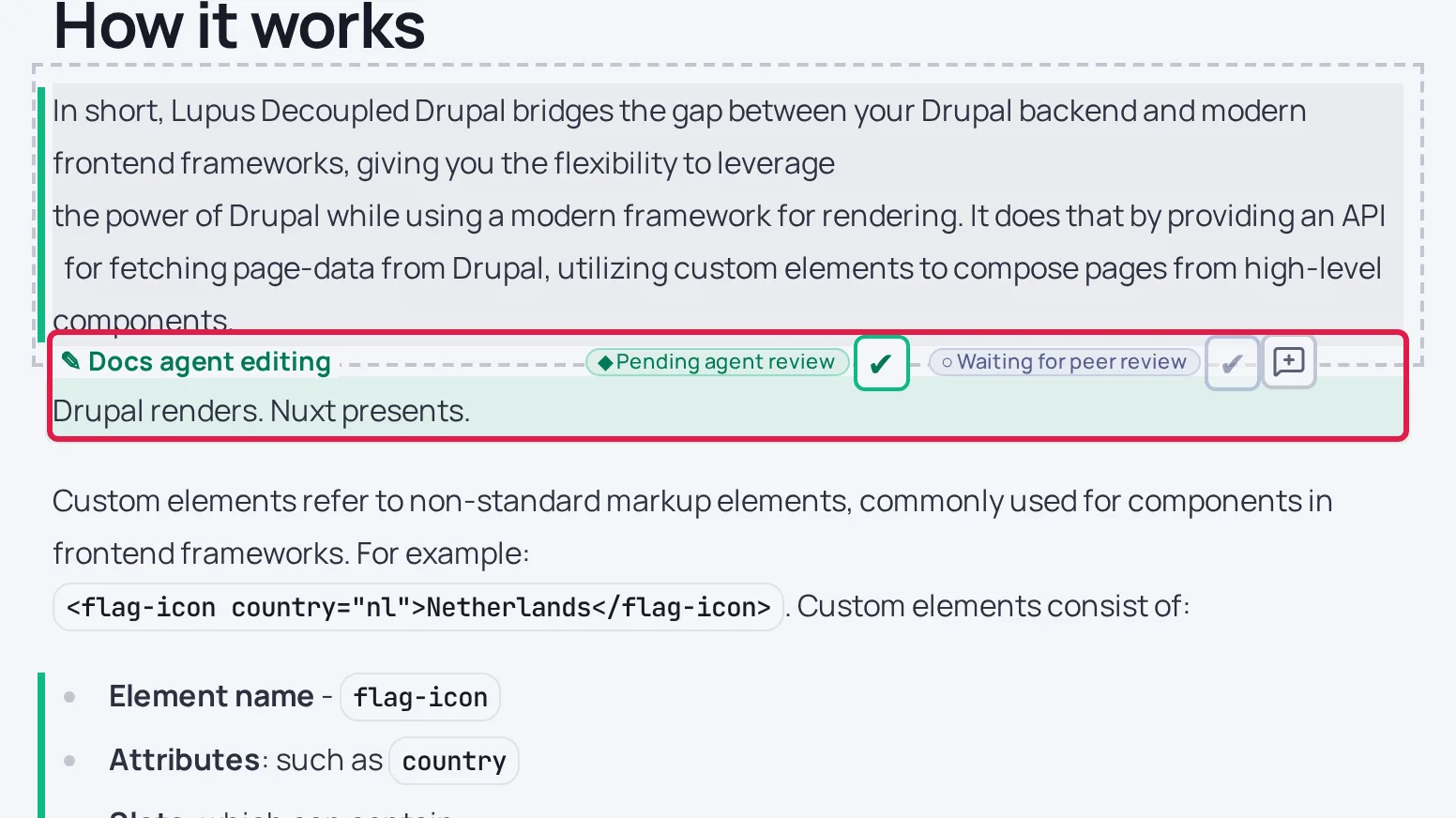
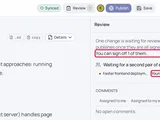
Review covers the whole diff: new blocks, edited blocks, changed titles, deletions. Every change is recorded against the person who made it, and the person who wrote a change cannot approve it. Most often the agent writes and a person approves or flags.
Each space decides what it wants. Review before publishing, or straight to published for scratch notes, and separately whether agent edits need a dedicated agent review on top.
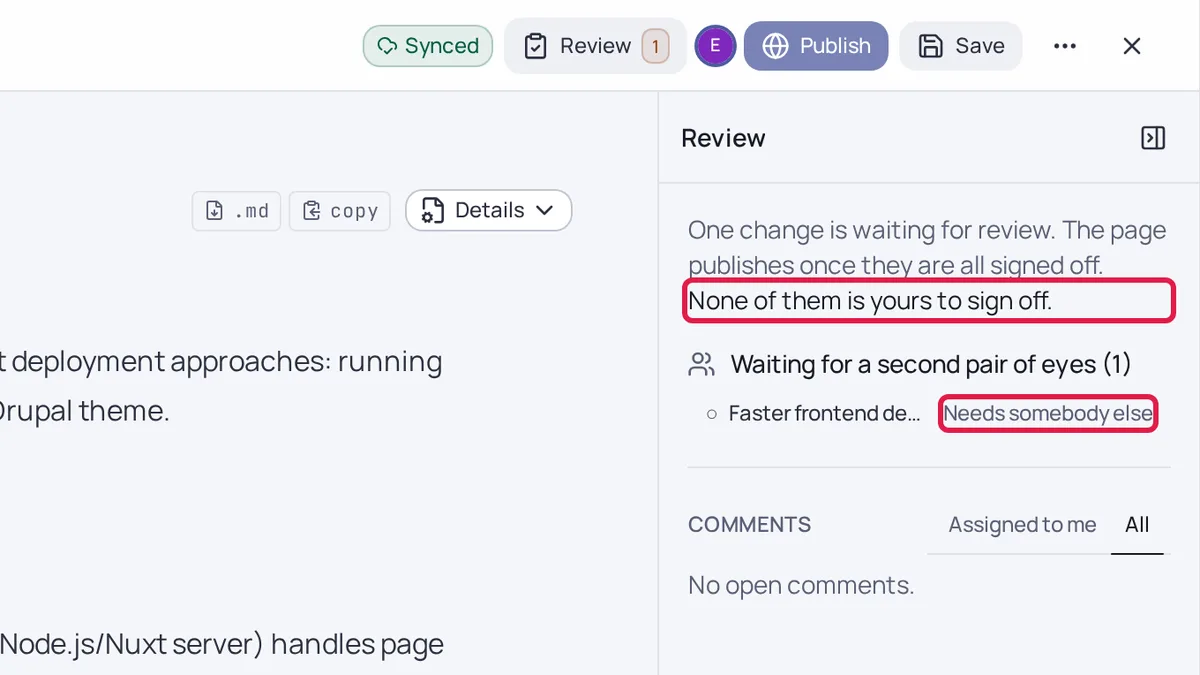
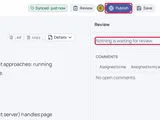
Shown in the screenshots:
- The person who wrote a block of text cannot also approve it.
- The reviewer sees what they can sign off, and what they cannot.
- Approving is a single click.
You control the agent
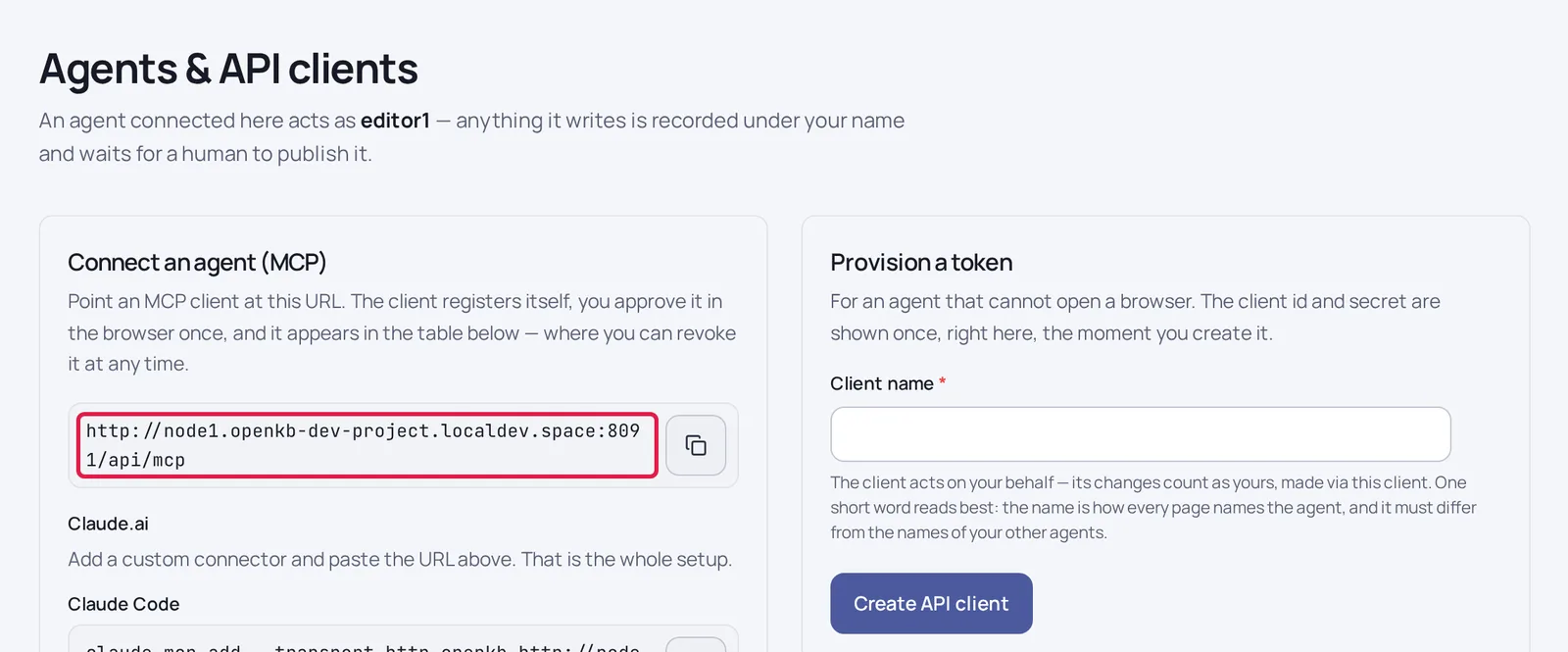
In OpenKnowledgebase, the MCP server is built in. Connecting the agent is a simple URL. Paste it into Claude Code, Cursor or any MCP client. The client registers itself, you approve it once in the browser, and it runs under your account with your permissions. No client secret to copy. No config file to hand-edit. An agent that cannot open a browser receives a provisioned token instead.
Every answer cites the block it came from
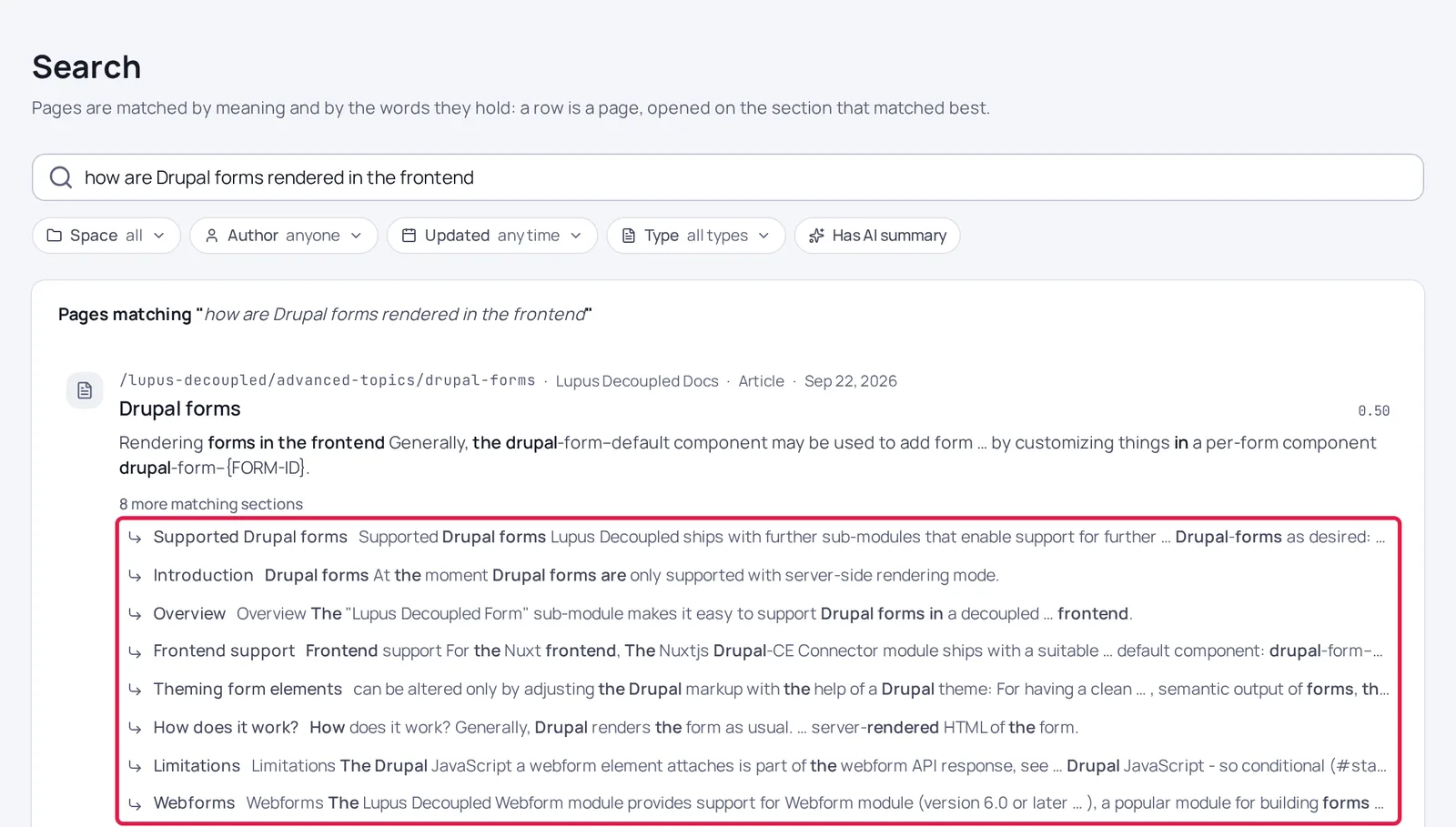
Ask a question and the answer comes back with its sources attached. Not a page reference, but the block the sentence came from, linked so you land on it. And when nothing in your knowledge base supports an answer, it says so instead of inventing one.
Search works the same way. One query ranks by meaning and by the words a page actually holds, and a result opens on the section that matched.
A page-level citation is an invitation to go and read. A block-level citation is a claim you can check in two seconds.
A text editor people will actually use
The editing surface decides whether a knowledge base gets used at all, so it got real attention. Selecting text opens a bubble menu, slash commands insert blocks, and inline comments attach to the passage rather than the page, with a marker you can click and an assignee who can be a person or an agent. There is a picker for linking between documents, table controls where the table is, and revision history in the app.
Pages are Markdown underneath, and both the frontend and the editor render Vue components, so a team can extend what a page is able to contain. That extension API is the main way we expect people to build on OpenKnowledgebase. It is not published yet.
Space-based access control
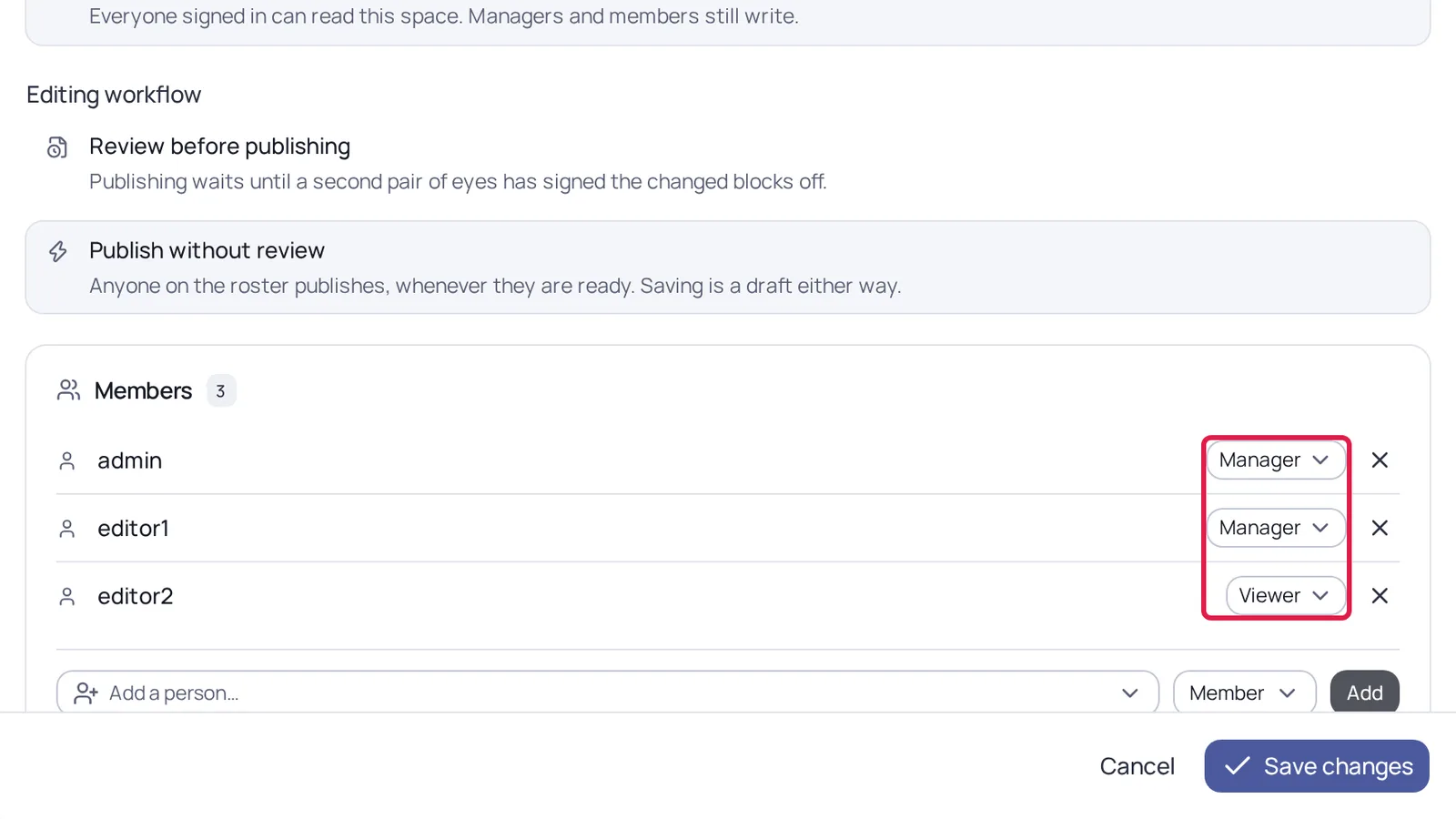
Content lives in spaces, and access is granted per space. Manager, Member and Viewer are set on the space itself, so a manager of one space has no access to another unless someone adds them. Read access and the review policy are per space too, and URLs stay clean.
Built on Drupal, Nuxt and Lupus Decoupled
OpenKnowledgebase uses Drupal 11 with the Drupal AI stack on the backend, while Nuxt 4 is used on the frontend, held together via Lupus Decoupled. OpenSearch for keyword and vector retrieval in one engine. These are contributed Drupal modules and Vue components, open source.
OpenKnowledgebase also gives back. Its fiber shield, which the MCP server required, was developed and pushed upstream into the PHP MCP SDK rather than staying a local patch.
Shipping in Beta 1
What Beta 1 actually gives you:
- Pages in Markdown, organised in spaces. A block-level editor with real-time collaboration for people and agents in the same session, inline comments, slash commands, page links and block anchors, images through the media library, tables and task lists, and a Markdown view you can copy or export.
- Review before publish. Attribution per change, sign-off, and per-space settings for whether human and agent edits need a reviewer, on top of draft/published moderation and page history.
- AI chat with citations. Block-level retrieval, a scope picker for space and page context, source links, and an honest "no source" when there is none.
- Hybrid search. Keyword and semantic together on OpenSearch, with space, type, tag and freshness filters, access-aware, and one retrieval layer serving people, chat and agents alike.
- Agents as first-class users. An MCP endpoint for search, read, create, update and listing spaces and assignments; OAuth clients with narrowed scopes; connect-by-URL with client registration; a consent screen in the frontend; and a page listing every agent connected to your account.
- Vendor-agnostic AI through Drupal AI, with OpenAI as the default and Anthropic and Mistral providers shipped.
- Self-hosting that works. A four-service compose stack and GHCR images for amd64 and arm64 with provenance, plus the quickstart.
What comes next
What we are working on next:
- AI prompt blocks, so the assistant works inside the editor rather than beside it.
- A references pane: what a page cites and links, and what links back to it.
- Persistent chat conversations, a per-user chat budget, and file attachments in pages and chat.
- Finer-grained agent-review settings.
- Adopting the OKF open spec, under consideration.
- Making Drupal the admin host only.
- Better retrieval and tool use, for both the chat and MCP.
- Better documentation.
- A published API for extending OpenKnowledgebase with your own components.
After that we want to bring in more of what the Drupal AI initiative is building, AI content reviews among them.
Who benefits most from OpenKnowledgebase?
The two most common scenarios:
- Teams currently using a Confluence-style wiki, yet needing collaboration without giving up control of where the content lives.
- And teams leveraging AI to update their internal documentation who have found that the model is not the hard part. The trustworthiness of what the AI generates is.
It is a beta
The feature set works and is tested. Interfaces, though, may change between Beta 1 and Beta 2. If you run it and something is wrong, we want to hear about it while it is still cheap to change.
Try it
The fastest way to judge any of this is to run it. A couple quick commands and the whole thing is on your machine:
mkdir openkb && cd openkb
curl -fsSLO "https://raw.githubusercontent.com/openkb-app/openkb/1.x/quickstart/{docker-compose.yml,.env}"
docker compose up -d
The quickstart walks through it, including what to change before you point it at anything real.
All of it is open source in the self-hosted edition: MIT for the frontend, GPLv2+ for the Drupal backend. No open-core, nothing held back. Your data, your model keys and your code stay with you, on infrastructure you choose. Hosting and support from us are options, not the way the product is paid for.
The code is on GitHub, and openkb.app has the overview and the newsletter, which gets you a mail when there is something worth telling you.
And if you are at DrupalCon Rotterdam, come to our BoF, Building a Drupal based, open Knowledgebase with Drupal AI, on Tuesday 29 September. We would like to hear what you make of it.